Mind Your Language!
The subject of our discussion is language.
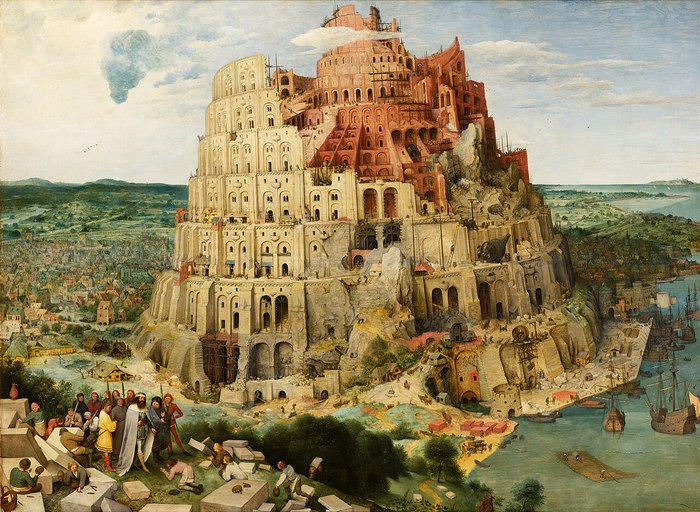
In the famous Bible story of the Tower of Babel mankind originally had only one language. This made cooperation in building a tower to the heavens simple but as a result of mankind's hubris God destroyed the tower and fragmented their languages. There are now 6,000 languages in the world but they are dying off at an increasing rate. It is easy to see why ancient people would have viewed the variety of languages as a punishment and a curse. If you can't communicate with nearby tribes you can't easily trade with them or make peace after a conflict. But in the modern age many see the demise of minority languages as a tragedy, akin to the loss of biodiversity in nature.
There have been many attempts over the centuries to develop an International Auxiliary Language so that everyone can return to pre-babel days. Latin served this function, via the church, for centuries, but in recent years Esperanto has been the most famous---and significantly unadopted. But why should that matter when we have English! It is the language of sea and air travel and has led to the English being very lazy in learning foreign tongues. Is this a matter for national shame?
A Bible Lesson
In the story of the Tower of Babel in Genesis chapter 11 God punishes mankind for their hubris in trying to build a tower to heaven. It is envisaged that originally mankind had only a single language and that punishment took the form of destroying the tower and then fracturing mankind's linguistic homogeneity. Multiple languages meant people couldn’t communicate and so they couldn’t cooperate easily. We can see why ancient people would experience multiple languages as a curse and a punishment. It would become difficult to ascertain whether another tribe was hostile or friendly and it would be very difficult to negotiate prices when you wanted to trade.
It was traditionally believed that as a result of the fall of the tower there were originally 72 languages but the reality today is that there are about 6,000 languages. I say ‘about’ as it is difficult to make a hard distinction between a language and a dialect. About 500–10,000 of these languages are spoken by only a handful of people and they are dying off at a rate of 250 a decade. Experts say that by the year 3000 just 600 languages will be left.
What is striking is that while ancient people viewed fewer languages a blessing, in the modern world many think that the death of any minority languages is a tragedy. For instance the linguist David Crystal considers the death of languages as equivalent to the loss of biodiversity in nature and thinks that we all suffer cultural loss as a result. On the other hand the writer Kenan Malik in his article ‘Let Them Die’ (2000) considers that if a language is not fulfilling its function as a means of communication then there is no benefit in keeping it alive artificially.
It’s true that in the past suppressing a community’s language has been a powerful means of social and political control but should governments today be financing programmes for supporting a secondary language that only a small minority are using.
In the British Isles and Ireland we have seven indigenous languages but not a lot of speakers:
● Scots: 1.5 million
● Welsh: 538,300
● Irish (Northern Ireland): 228,600
● Ulster Scots: 190,000
● Scottish Gaelic: 57,600
● Cornish: fewer than 1,000
● Manx: 2,000
Shouldn’t we just treat these languages as hobbies for those who are interested? Should the BBC be spending money on Welsh programming for only half a million citizens?
Foreign languages in the UK
In contrast to many European countries the UK is 85%–90% monoglot. In the Netherlands over 90% speak at least one foreign language. In Sweden it’s around 85–90%, and in Germany it’s around 60–70%. Is this grounds for national shame?
Language teaching in the UK is now on the national curriculum but schools report problems in specialist teacher recruitment and university courses have reduced.
But does this matter? After all English has become the de facto international language. It is used in shipping, air transport, technical documentation and so many other areas of life. So why should we Brits be bothered about speaking their language when they can all speak ours?
Or are there other reasons for learning another language? Does it change your view of the world? Does your personality change when you are immersed in another language?
Let’s talk about language!
Bilingualism
● Tynged yr Iaith (The Fate of the Language, 1962)
● Provision of Bilingual Services in Wales
English
● How many English people speak a second language?
● Controlled/Restricted Forms of English
● Watch your language: AC Grayling vs Jean Aitchison
Foreign Language Teaching
● Modern foreign languages are not in crisis. It’s worse than that
● The current state of foreign language teaching in England
● The current state of foreign language teaching in England
● The Death of Modern Foreign Languages
● The Strange Persistence of First Languages
International Auxiliary Languages
● Thoughts on International Auxiliary Language Success
● Design of an International Auxiliary Language
● Farewell to Auxiliary Languages
Minority Languages
● The Story of the Tower of Babel (Gen 11:1--9)
● Are Dying Languages Worth Saving?
● Assessing the Value of Dying Languages
● Scientists Fret as One Language Disappears Every Fourteen Days
● Revitalising Native American Languages
● Foundation for Endangered Languages
● How to Save a Dying Language
● Six Last Living Speakers of Dying Languages
● Smithsonian Archives Preserve Lost and Dying Languages
● Ten Languages on the Verge of Extinction